

His name was Viktor Riemann.
In Rhineland-Palatinate, everyone knew him. Not personally — but they knew his buildings.
Those long residential blocks with the bright balconies. The medical centers. The senior residences. The shopping centers near motorway exits. His name was everywhere: on construction signs, and eventually even on donation lists.
He was one of those men who came from nothing and, at some point, was only ever seen in the back of a black car with a chauffeur.
At eighteen, he had slept on construction sites.
At thirty, he had organized his first work crews from Poland.
At forty, he owned several companies.
At fifty, he was rich enough to never have to work again.
But he could not sleep at night.
Not because of the money.
Not because of fear.
But because of something else.
Something he had never spoken about.
A Promise He Had Forgotten
His mother had died early.
Not suddenly. Slowly.
She had cancer when Viktor was fourteen. His father had been a hard man. A master bricklayer. An alcoholic. A grandson of war.
Feelings were weakness.
Crying was forbidden.
His mother lay for months in the living room on a care bed. At night, Viktor could hear her coughing. For hours.
Once, she had taken his hand and said:
“Promise me just one thing. Never become as cold as your father.”
He had nodded.
But that was exactly what he became.
Not cruel.
Not evil.
Just inwardly made of stone.
He built houses, but no home.
He bought his wife jewelry, but did not see her pain.
He gave his son cars, but no closeness.
At some point, his son Lukas barely spoke to him anymore.
And then came the day that changed everything.

The Hospital Corridor
Lukas had a motorcycle accident.
Nothing dramatic, the doctors said at first. A few broken bones. Observation.
But during the second night, he suffered internal bleeding.
Viktor sat in the corridor of the intensive care unit and waited alone for seven hours for some doctor, some news.
His wife had collapsed.
His son was lying between life and death.
And there, on that cold hospital chair, something happened to him.
For the first time in decades, he felt fear again like a child.
Not control.
Not power.
Not money.
Only naked helplessness.
He began to tremble.
He could barely breathe.
And then someone sat down beside him.
Elias Winter
A man in a dark sweater, in his early forties. Calm eyes. No haste.
“You have been holding everything together for years,” the stranger said quietly.
“But right now, everything is falling apart.”
Viktor looked at him as if someone had cut open his thoughts.
“Do we know each other?”
The man shook his head.
“No. But I know that look.”
The stranger’s name was Elias Winter.
He was 44 years old.
Not a classic coach.
Not a guru.
Not a salesman.
He had once been a psychologist. Then he had lost his wife and daughter in a car accident.
After that, he had given everything up.
Clinic.
Career.
Titles.
Now he lived simply. Cooked for people in crisis. Accompanied the dying. Worked with traumatized teenagers. Meditated. Read philosophy. Often remained silent.
Later, he once said to Viktor:
“Most people come to me because they want to achieve something.
You were the first who only wanted to feel again.”
Closeness Without a Price
Lukas survived.
But Viktor did not.
At least not the old Viktor.
He began meeting Elias. First once a week. Then every day.
And it was strange, because Elias wanted nothing from him.
He never asked for money.
Never for contacts.
Never for favors.
Instead, he cooked.
For hours.
Simple things. Potato soup. Roasted vegetables. Fresh bread.
And Viktor did not understand why that touched him more deeply than any Michelin-starred restaurant.
Once he asked:
“Why are you doing all this for me?”
Elias answered:
“Because no one ever showed you that closeness does not have a price.”
That hit him harder than anything before.
Everything Had Been Walls
Over time, Elias became something Viktor had never had.
Not a friend.
Not a therapist.
Not a father.
More like a second consciousness.
When Viktor had panic attacks at night, Elias drove to him.
When Viktor sat silently in the garden, Elias sat down beside him.
When Viktor cried, Elias did not say, “Everything will be fine.”
He said:
“Stay here. Don’t run away this time.”
And slowly, Viktor understood something terrible:
He had built his entire life so he would not have to feel.
The houses.
The companies.
The success.
The perfectionism.
All walls.
The Old Worker
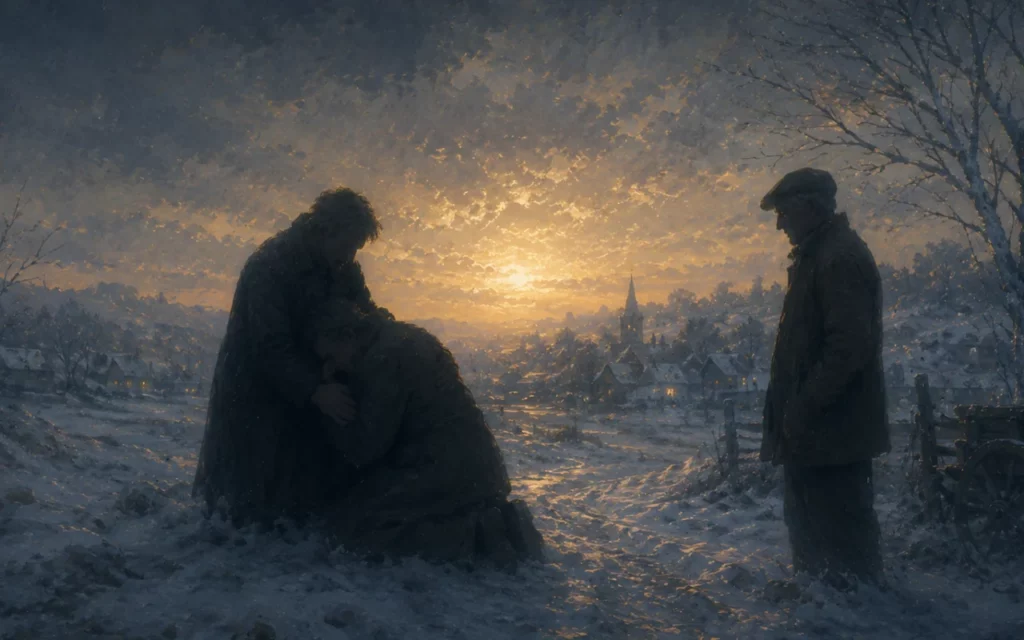
One winter, they traveled to Poland together.
To the village where the first workers had come from — the men Viktor had brought to Germany back then.
There, Viktor met an old man again. Piotr. One of his first construction workers.
Piotr took his hand and said:
“You gave us work. But you were always sad. We knew that.”
There, Viktor broke down completely for the first time.
In the middle of the snow.
At 56 years old.
Like a boy.
And Elias simply held him.
Not like a coach.
Not like a teacher.
Like someone who had understood that some people do not break because of money — but because they were never loved without having to earn it.
Human Instead of Profitable
After that, Viktor changed many things.
Not spectacularly.
He did not sell everything.
He did not move into a monastery.
But he began to truly live.
He spoke with his son.
He learned to cook.
He visited the families of his workers.
He had apartments built that people could afford.
Not profitable.
Human.
And at some point, he said to Elias:
“I have earned millions.
But you are the first person who showed me that I even exist.”
Elias only smiled.
“No,” he said quietly.
“I only helped you become the boy again who once sat at his mother’s bedside.”